

Virtual reality has traveled a great distance from being a gaming & entertainment device. Now, it is applied to bring about a paradigm shift in the way of modeling, testing, and presentation of ideas and concepts in various industries.
One such application of 3D modeling in virtual reality is that allows the user to walk through the design of the product at full scale before it is physically manufactured. Through the user entering a virtual universe, 3D modeling helps to understand the space, scale, and usability of the product in a way that would not be possible in a traditional drawing.
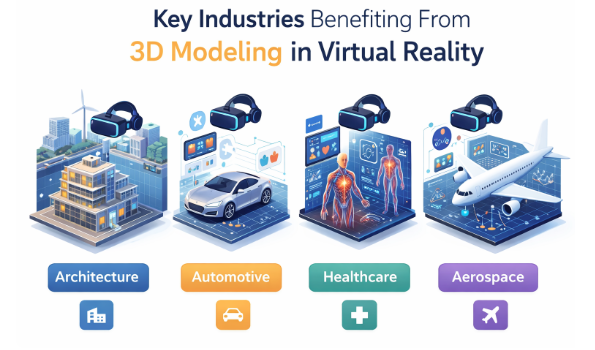
Against the ever-growing demand for precision, fast pace, and teamwork, various sectors rely on virtual reality to diminish the consequences of mistakes, quicken the decision process, and improve results. The list below shows the main fields already profiting significantly from virtual reality 3D modeling.
Architecture and Real Estate Development
Architecture is among the earliest industries to employ virtual reality design systems and also among the most extensive users. Now, architects can offer their clients a tour of the proposed building before construction, giving clients a more natural understanding of design, size, and working of the building than they have ever had before.
Rather than trying to deduce the building from the 2D drawing or a computer model, one can walk through the actual building to anticipate ceiling heights, room sizes, views, and functions in a speedier fashion. The clients will be able to comment faster with no miscommunication, and will be able to put their approvals forward faster. Another potential application for the experiences would be for real estate developers who want to enhance their presentation material to attract investors, making something unbuilt become tangible.
Construction and Engineering
In the architecture, construction, and engineering industry, errors that come at the end of a project can cost a lot to rectify. Virtual reality environments permit designers to find conflicts in design and discover contradictions prior to leaving the design studio.
Engineers can analyze the structure, services coordination, and access routes in a more realistic environment. Contractors can analyze the sequence, site logistics, and safety analysis in a more realistic environment. This will bring rework out, benefit discipline coordination, and easy execution at the site.
With spatial design validation, engineering experts implement a constructability study and retain their mind on design.
Manufacturing and Product Design
In manufacturing, immersive modeling enables companies to refine solutions before physical manufacture. Shape, ergonomics, assembly, and performance can be tested by designers and engineers in a computer-generated virtual world.
This will enable teams to see how a product will be felt at a human scale, reveal potential design conflicts early, and iterate rapidly without having to produce physical prototypes. Fully immersive analysis is most used for complex machinery or industrial-sized equipment, and yields results not obtainable through screen analysis.
More products will be introduced to the market at a quicker rate, with less costly modifications.
Automotive and Transportation Design
The automobile industry focuses on reproducibility, ergonomics, and usability. Using virtual environments, designers can explore their designs, testing the visibility, usability, and accessibility of interior designs without having to produce any part of the car.
Similarly, other experts can also analyze labor flows in manufacturing companies, analyze assembly lines, and analyze spatial occupancy. 3D immersive analysis allows manufacturers to optimize design, safety, and ergonomics through the design process.
Transportation Infrastructure Development
Transportation infrastructure projects involving airports, train stations, and terminals are likewise amenable to the use of human-scale spatial analysis.
Urban Planning and Smart Cities
Today‘s urban development planners face large and complex environments where the factors of scale and context are important. Using virtual modeling, the planners, government, and society can assess the impacts of projects and developments on existing communities.
They can simulate building design, car and foot traffic, public spaces, and even environmental conditions. Being able to simulate such things in a totally immersive environment makes more transparency possible, and lets decision-makers make better-informed choices at public hearings and other approving bodies.
Optimizations in smart city projects are possible too, thanks to immersive environments where up-to-date layers of data (mobility, energy, population flows, etc…) can be merged to build 3D representations with high fidelity to real-world data.
Healthcare and Medical Training
While mostly overlooked, the healthcare industry is increasingly embracing immersive technology. Hospitals and healthcare centers are utilizing virtual environment solutions to help layout and improve the patient experience.
Providers in health care have the opportunity to move through the OR’s, ER’s, and patient areas to have maximum efficiency, safety, and usability. In education rooms, realistic environments allow students and providers to practice procedures and navigation in a safe environment.
This helps prevent mistakes being made in the design of healthcare environments. This also aids the decision makers throughout the healthcare industry, leading to ensuring that the decisions made are effective.
Education and Professional Training
Apart from this, the industries of education and professional training can be immensely helped by experiential learning. Virtual reality can help in the experiential learning of difficult concepts.
Architecture students can take a walk within their designs; engineering students can have a clearer concept of the space; and vocational students can practice their skills in a virtual environment. This helps them stay confident and understand in a way that the traditional learning process may not accomplish.
All professional sectors are now including immersive technology to make professional training a more effective way.
Retail, Hospitality, and Experience Design
Customer experience is an important part of retail and hospitality. Virtual walkthroughs help designers and hospitality players to preview store design, hotel rooms, restaurants, and experience environments before a real design and implementation.
Designers and hospitality industry experts are able to analyze the sightlines, circulation, lighting, and ambiance, creating an environment that supports the brand, identity, and comfort. For investors, this helps provide clarity and reduces risk, making it easier to invest intelligently.
Immersive walkthroughs help the designers, hospitality industry professionals, and marketers to develop a mutual understanding.
Entertainment, Media, and Experience Production
The use of immersive modeling is also a factor in the entertainment industry. Beyond design and implementation work that requires it, it is also used for theme parks, exhibitions, museums, and events in the virtualization of visitor routes.
Below are questions they can help answer: How do users navigate across the environment where focus points should be? How does scale influence emotional experience?
Role of Professional Visualization Partners
As technology in immersive modeling progresses, many companies are now seeking out professional 3D visualization companies to assist in the creation and maintenance of high-quality virtual environments. This is because a professional 3D visualization company has both the experience and technology to make sure the models are precise and optimized for immersive modeling.
This collaboration with professional visualization firms allows them to use VR in their business without disturbing the way they work, thus receiving a faster ROI.
Conclusion
A requirement for increased accuracy, improved communication, and quicker decision-making has arisen in many fields. It is here in the growing fields of Virtual Reality and 3D modeling that the usefulness of the former has been demonstrated. It has proved to be a very useful tool that has allowed engineers and architects to walk through scaled-down designs, uncover problems before production begins, and collaborate more effectively.
With actual technology and the standards always being pushed higher, companies that are utilizing immersive modeling will be better prepared to manage risk, quality, and accomplish a goal that aligns with the world.